
%20(4).png)

Pallavi’s First Complaint: When Awareness Became Action
- We, The People Abhiyan
- Apr 9
- 3 min read
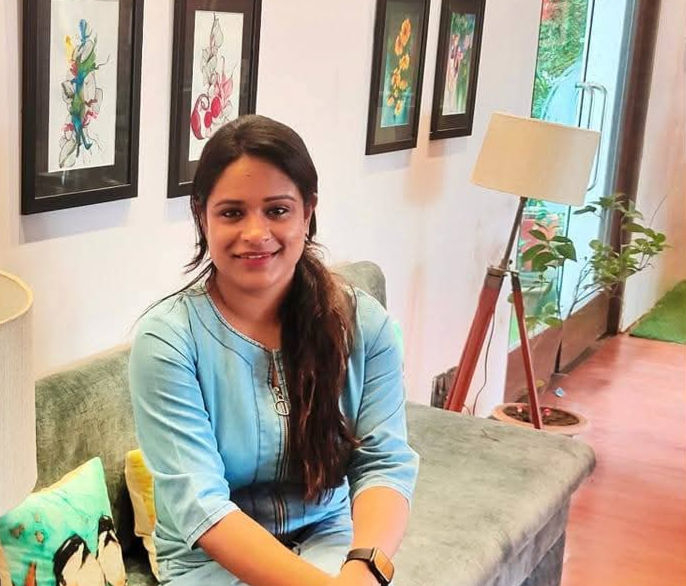
Pallavi has always been attentive to injustices around her.
Since 2025, she has been working with youth from Darjeeling and Kalimpong districts as a Program Lead at the Eastern Himalayan Foundation. Through her work, she saw structural gaps clearly - in education, in access, in opportunity. She met students who were capable but held back by financial constraints, language barriers, limited exposure, and poor digital access in remote hill areas. She understood how systems shape lives long before young people make their own choices.
For her, these gaps were not limited to education. They were part of a larger system, visible even in everyday civic life. In Darjeeling, concerns like waste dumping, polluted jhora water, and irregular drinking water supply are common. But since February 2025, just after she had joined EHF, she noticed that the streetlights on VIP Road, one of Darjeeling’s main roads,
were not functioning properly. Many nights walking back from the office, she had to walk along the road in pitch-black darkness. Sometimes, she would stumble, few times she felt fearful. But it was in August of the same year, when her parents had come visiting, and they were walking along the dark road, her father pointed out how unsafe this was. This worry that her father felt stayed with her.
So, in December, when, as part of the training with We, The People Abhiyan, she got a practical opportunity to file a complaint, she grabbed it with both hands. Immediately, she filed a complaint about the street lights on VIP Road using the West Bengal grievance redressal portal. The complaint was registered.
Pallavi then went off on leave to her hometown, and when she was back in January, she walked eagerly back from the office. Night had already fallen. As she came into VIP Road, there she saw it. The road was fully lit. The lights had been repaired. Two months have passed, and the good thing is that they have stayed that way!
“It was a small action, but a powerful moment for me,” Pallavi reflects. “I was surprised by how straightforward the
process was. I realised that when we know the right channels, our voices actually matter.”
The experience of active participation stayed with Pallavi. She realised that systems are not only structures that affect people; they are also mechanisms that can be approached and used. After this experience, her engagement became more intentional.
In her work, she began integrating civic awareness into her sessions with young people not as a separate topic, but as part of how they think about education and opportunity. She started guiding them on how to access verified information independently, how to navigate official portals, and how to understand their rights and responsibilities as citizens. Instead of seeing themselves only as beneficiaries of schemes or services, she encouraged them to see themselves as participants in active citizenship.
Personally, too, she felt a stronger sense of ownership. Conversations about equality and justice in education began at home with family and friends. When her domestic worker considered marrying her daughter at a very young age, Pallavi chose dialogue - discussing legal age, education, and long-term security. The family agreed to let the girl complete her graduation.
For Pallavi, active citizenship did not remain an abstract topic for her. “It is a balance between rights and duties,” she says. Along with her work in the community, she now sees herself as someone responsible for engaging with civic systems - ethically,
constructively, and consistently.
The above story has been written and published with the explicit consent of the individual involved. All facts presented are based on WTPA's direct interaction with the individual, ensuring accuracy and integrity in our reporting.


Comments